
Outdoor brand content doesn’t usually fail because you missed a comma or used the wrong joke. It fails because it doesn’t feel authentic or add any value.
- Caliber comparisons that sound like spec sheets
- Gear reviews from authors who have never touched the product
- “Hunting tips” that could come from anyone, in any region, during any season
Those basic articles that anyone could write do not add a ton of value to a given conversation. The days of skimming the first few articles off a Search Engine Results Page (SERP) and rewriting something that covers everything they covered is over. AI will beat you everyday of the week and twice on Sunday.
If you do manage to get a click, a savvy reader sees those shortcomings after just a few sentences. When readers pick up on that, they don’t scroll down, or comment, or share, they leave. Google is reading that behavior, and it impacts your ranking.
Outdoor, hunting, and firearms content lives in an experience-based world. The audience reading it has been in the field, whiffed on shots, had gear break, and learned lessons the hard way. When content doesn’t match that experience, it loses trust in the background, and rankings right along with it.
The good news? Addressing that problem doesn’t require chasing the algorithm or cranking out more content. It requires building articles on the foundation of authenticity: writing about things you’ve done, using actual photos, and reviewing products you’ve actually used.
Writing About Things You’ve Never Done Is a Ranking Liability
In the outdoor space, experience isn’t a nice-to-have. It’s the difference between content that earns trust and content that quietly bleeds traffic.
A writer who’s never hunted whitetail can still write an article about a deer rifle. They can name calibers, quote ballistics tables, and recap manufacturer claims. They can’t convey why one setup matters over another when you’re hacking through brush with a climber or sitting in an elevated blind over a field edge.
The difference becomes glaringly obvious very quickly. And the gap between those articles is night and day.

Articles from authors who lack hands-on experience tend to recycle the same information: safe conclusions, generic recommendations, and a total lack of tradeoffs. Every product “performs well.” Every cartridge is “capable.” Every scenario is a “winner” on paper.
Seasoned readers know this isn’t how it plays out in the field.
And when readers sense that the author is learning the topic while writing it, they disengage. They skim less. They trust less. They leave sooner. Search engines pick up on those patterns and respond accordingly.
This is why technically accurate outdoor content can still fail to rank.
Search engines aren’t evaluating your content, they’re evaluating your readers’ response to your content. Experience-based content has lots of value signals that are difficult to fake: failures and limitations, side effects, implementation-specific advice, etc.
Those details are what keep people reading, because they’re how you know something’s actually being used in the real world.
Repurposed content, on the other hand, is fungible. It has no value-add, and it doesn’t encourage people to keep reading.
In a world where AI can scan the top ten SERPs and spit out a summary in seconds, publishing experience-less content is less than worthless: it’s a high-cost liability competing head-to-head against systems specifically designed to do that task, but at hundreds or thousands of scale.
You can’t out-write AI by better prompts or more word count. The answer is experience. Writers who have actually done the thing they’re writing about make content that gets attention, and sends the right signals back up to search engines.
Plus, real-world experience is the one thing AI will never be able to replace.
If you want to read more about the struggle against AI for writers and how to beat it, check out our other article: AI Can Write, But It Can’t Hunt: Why Outdoor Brands Need Real Voices
Real Experience Produces Signals Google Can Measure
Authenticity isn’t just a brand preference. It produces measurable signals that search engines can see.
Signal number one is engagement. Readers respond differently to articles written from experience. They linger longer. They scroll farther. They read more than one section instead of bouncing after the intro.
Engagement signals like those are precisely what search engines analyze to determine whether a piece of content actually fulfills the query.
Outdoor content based on firsthand usually answers the follow-up questions readers didn’t know how to phrase but which they will eventually want to know. Why a cartridge that looked great on paper ultimately didn’t perform. Which one you would pick differently now.
Those details hold a reader on the page because they feel helpful, not regurgitated.
Less pogo-sticking back to the SERP because they’ve found what they were looking for. The more help a post provides, the more a reader is likely to bookmark it, share it, or link to it in forums and social groups. That compounds over time, adding backlinks and brand mentions naturally with no outreach necessary.
Thin content, by contrast, never earns those signals. It may attract a click, but it doesn’t hold the reader long enough for it to matter. To a search engine, that’s a page optimized to match the keyword but flunks the intent, and its ranking will fall accordingly.
Experience-driven content compounds over time, too. Articles that really help readers will continue to earn engagement years after publication, while thin content slowly sinks into obscurity. That’s why brands in the outdoor niche who invest time and effort into authenticity see more consistent rankings even as the algorithms change.
Search engines don’t need to know what hunting or shooting are to assess outdoor content. They just need to look at how people react to it. And people react differently when they can tell the writer has been there.
Stock Photos vs Real Field Photos: Why Visuals Matter More Than You Think
In this industry, photography isn’t an accessory, it’s evidence of experience.
If you have been on the internet for any time at all, you can probably eyeball a stock image from a real field image in less than a second. Symmetrical light, clean kit, and a bland expression can look cool, but they also look too clean. When you literally see the writer wasn’t in the field, that matters to the reader.
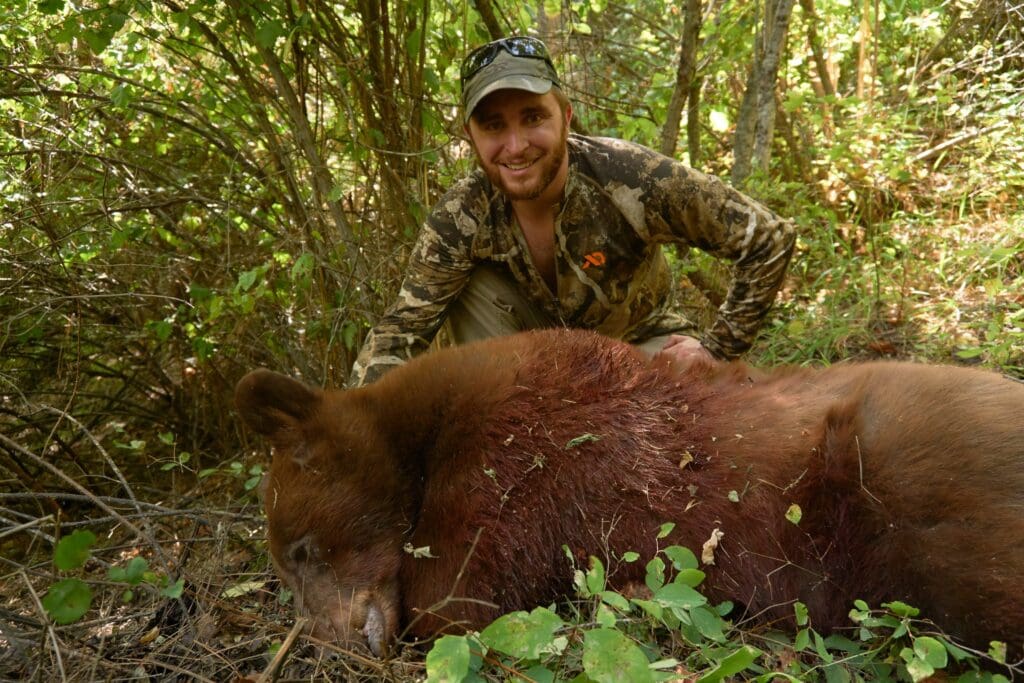
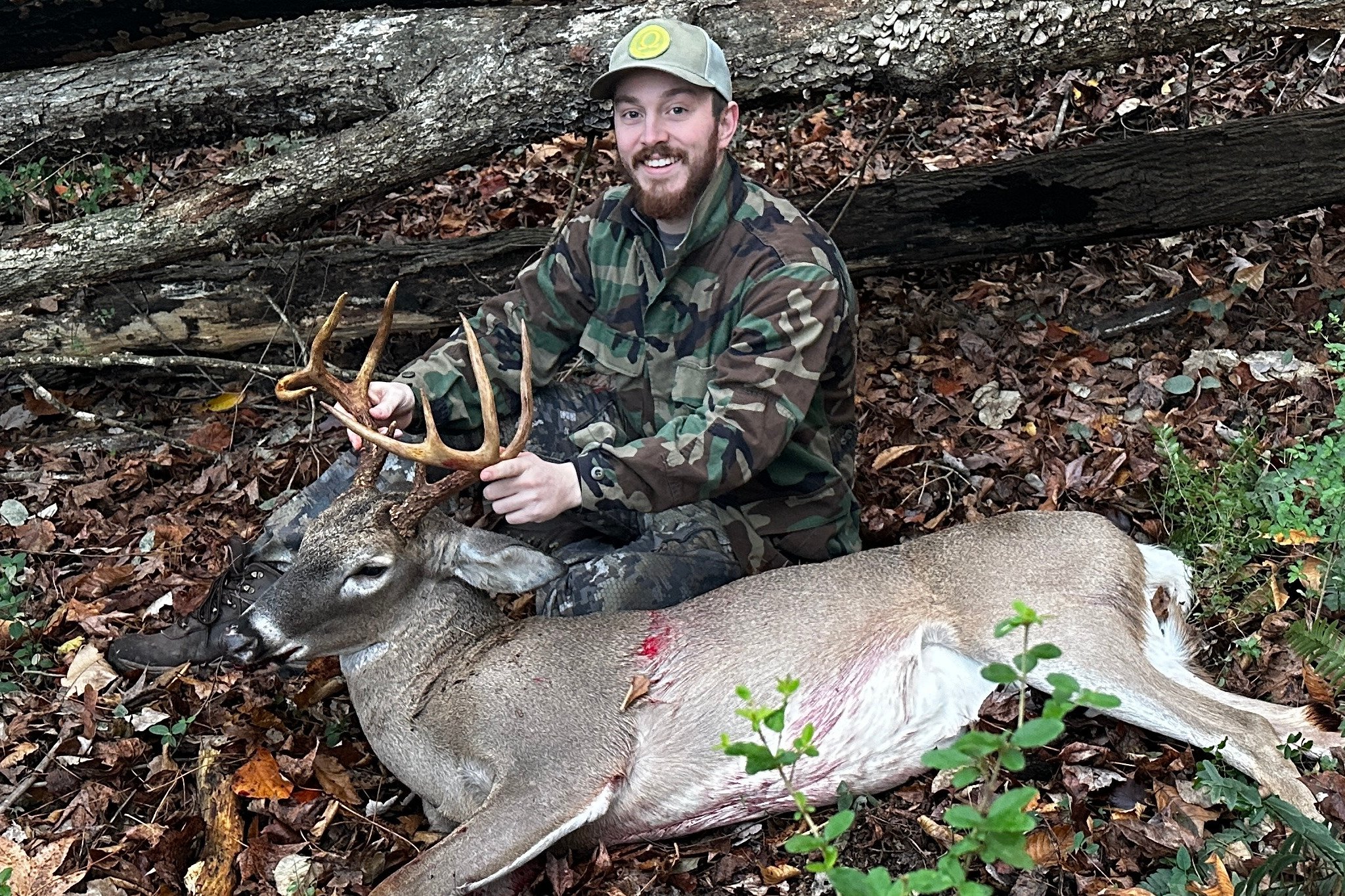
As an example, in this recent article we published for a client about the best side arm cartridges for bear hunting, we had our writer Dalton write it who actually had to use his 10mm side arm on a black bear hunt. You can’t have an experience that is so on-the-nose every time, but it's what we should strive for.
Original images make people slow down. It improves scroll depth and time-on-page, and reduces the urge to bounce back to the search page. From an SEO perspective, those are meaningful user engagement signals. Google doesn’t care if your content looks good, it cares if people engage with it.
More practically, original images make content more distinct at the SERP level. When dozens of pages are covering the exact same topic, pages with unique imagery are bookmarked, shared, and returned to more often. Over time, that becomes brand recognition and organic backlinks.
Stock imagery has no differentiation. The same few photos are sprinkled out across dozens of pages, adding no value, no credibility, and in the worst case actively damaging what would otherwise be a great article by making it look cookie-cutter.
Not every article has to have professional style photos though. Even if you are making a 9mm cartridge round up, taking original photos of the cartridges does a lot for the article.
It sets you apart from the generic articles using the same no-background manufacturer image. Plus, it lets the reader know that you actually have touched that cartridge, you didn’t just pluck a random one from your catalog.
The lesson for outdoor brands is simple: if you weren’t there, don’t pretend like you were. Real photos don’t need to be perfect, they just need to be real. Honesty beats polish every time when trust is the ranking factor.
How to Fix It: Building Content That Actually Ranks
To fix an underperforming outdoor website you don’t need more keywords, more articles or more SEO tools. You need a new approach to building content and who builds it.
Start with the writer.
Outdoor content needs to be written by hunters, shooters, anglers, guides, or long time enthusiasts who get the nuance behind a topic because they participate in the activity.
They know what can go wrong in the field. What matters under real conditions. What advice sounds good on paper but falls flat in the real world. Experience like that shines through in the content.
If your freelancers have to learn the subject while writing about it your rankings will always be tenuous.
Next, narrow your scope.
Brands tend to put themselves at a disadvantage by trying to cover every topic, subtopic and possible angle. Your topical authority is very important. We can be experts in a lot of areas, but not all of them.
Publish fewer articles rooted in experience. Write about products you’ve tested. Cover scenarios you’ve encountered. Volume will never outperform depth in experience-driven niches.
Then, use real assets.
Original photos, field notes, and firsthand observation don’t just boost credibility, they sky-rocket engagement. Readers trust what they can see. And search engines reward content that can hold a reader’s attention.
Flawless lighting and product shots matter far less than real-world, honest to goodness images.
Finally, build content with intent, not templates.
Start by adding value to the conversation. What surprised you? What didn’t work? What would you do differently next season? Those are the details readers will stick around for, and the ones search engines will learn to value over time.
For most outdoor brands this is the part where the gap appears. They know authenticity matters. They just don’t have the internal bandwidth or talent to consistently produce it at scale.
That’s exactly why C3 exists.
We work exclusively with outdoor brands and use vetted writers who actually hunt, shoot and spend time in the field. Our content isn’t designed to look good on a spreadsheet; it’s designed to earn trust, hold attention and compound rankings over time.
Because when it comes to outdoor SEO, authenticity isn’t a creative preference. It’s the strategy. If you want help with that strategy or need someone to lighten the load so you can get back to running a business, let’s talk.
End of the Line: Your Ranking Is a Byproduct of Trust
Outdoor brands don’t lose rankings overnight. They lose them little by little, article by article as readers stop caring about what they publish.
Generic caliber guides, surface-level product reviews, experience-free “how-tos” train both readers and search engines to expect less. Engagement drops, trust erodes and rankings fall. Not because any of the content is wrong, but because it doesn’t help the readers who actually know the space.
Real outdoor content does the opposite. It holds attention. It answers the questions readers didn’t know how to ask yet. It gets bookmarked, shared, and referenced long after it’s published. And that’s why it tends to outlast algorithm updates while thin content quietly dies.
Search engines don’t want to understand hunting, shooting or the outdoors. They’re watching how people react to content about those things. And people react differently when they can tell the writer has been there.
AI is only going to get better at summarizing the internet. It will never replace firsthand experience. That gap is where real authority lives, and where long-term rankings are made.
For outdoor brands, the path forward isn’t more content. It’s better content, built on real experience, honest visuals and writers who know the field. Because in outdoor SEO, rankings aren’t won by optimization alone. They’re earned through trust.
Trust that Crosshair Content Co. can help you with.