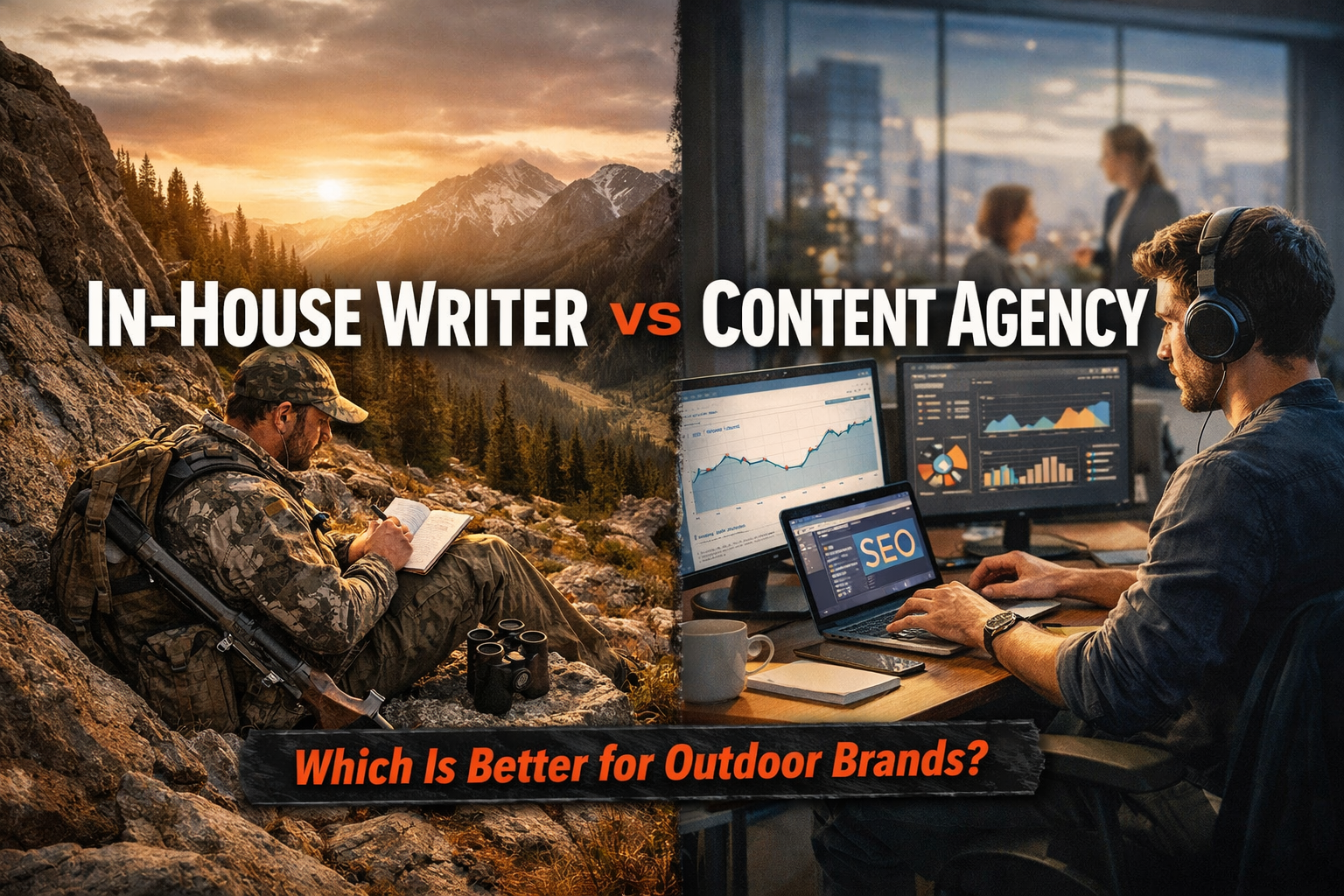

Nearly every outdoor brand we work with reaches a moment where content stops being optional and starts being a structural decision.
At some stage, most outdoor brands reach a similar inflection point.
Content is working well enough to invest in, but not well enough to neglect. Rankings are important. Authority is important. And suddenly the question isn’t whether to invest in content, but how to structure it.
Do you hire an in-house writer who will immerse themselves in your brand for 40 hours a week, or partner with a content agency that can scale both volume and expertise?
On the surface this looks like a cost decision. In reality, it’s a decision about leverage and risk.
Outdoor content is experience-led. It requires writers who understand what’s happening on the ground, editors who know what credible looks like, and processes that make quality sustainable at scale. The wrong model doesn’t just slow growth, it quietly undermines trust and erases SEO gains.
In-house writers can work for outdoor brands. Content agencies can work for outdoor brands. But both can fail for predictable reasons.
This article breaks down the real tradeoffs, so you can choose the model that fits your team, your goals, and the authority level you want to build.
What Outdoor Brands Actually Need From Content
Before we compare an in-house writer to a content agency, let’s establish what outdoor brands actually need from content to begin with.
In most cases, the problem is that teams optimize for output, when what they should be focused on is outcomes. After all, outdoor content isn’t about publishing seven articles a week. It’s about earning reader trust in an experience-first industry.
Put minimally, successful outdoor content has to do a few things consistently:
Authenticity: It has to be written by a real person who has first-hand familiarity with the activity they’re writing about. This is not a lifestyle writer googling “camping tips” to write an article, it’s someone who spends most weekends outside.
The readers in this space can sniff out inauthentic writing a mile away, and you can lose brand trust in an instant.
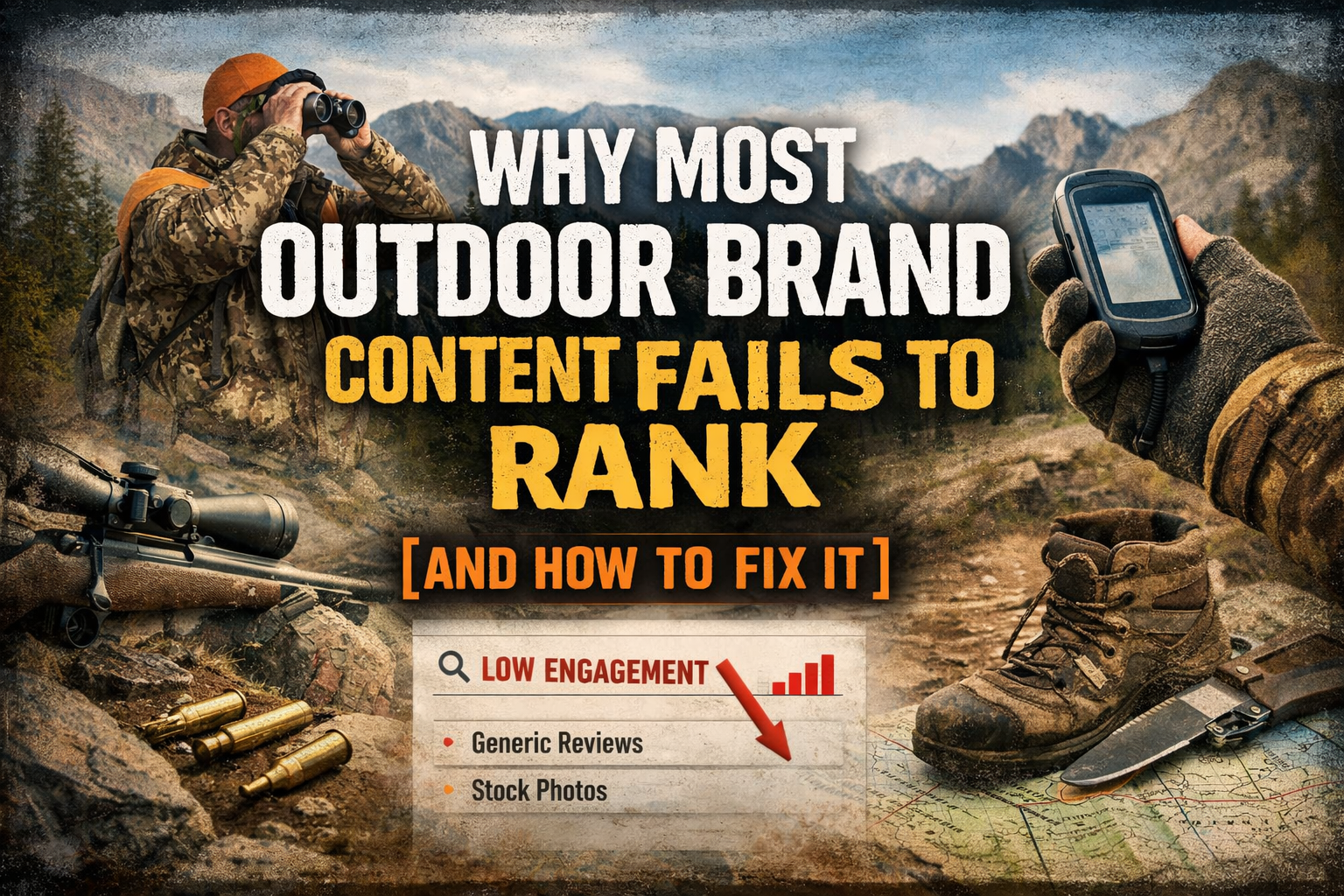
I wrote an entire article about this experience gap we commonly see, if you want to learn more about it check it out: Why Most Outdoor Brand Content Fails to Rank [And How to Fix It]
Content consistency: Sporadic publishing chokes SEO progress, but overworking one writer is a surefire way to see content quality begin to dip. Output is important, but you need to optimize for a cadence and volume that’s both sustainable and flexible.
This is an extremely common problem for smaller companies who task one or two people with creating content that also have plenty of other responsibilities in the business. At the end of the day, those employees have to complete the tasks that pay the bills, and content often takes a backseat.
Editorial control: The best writers still need to be guided, edited, and directed by an experienced hand. Without that layer, content quality starts to meander, angles are rehashed, and articles begin to get dull after a few months.
No matter how experienced you are, getting more than one set of eyes on an article before publishing it is essential.
SEO strategy, not just SEO markup: Keyword usage, internal linking, topical coverage, update cadence, etc. all of these are important, but only if they service and support genuinely valuable, reader-first content.
Flexibility to prioritize: Outdoor brands have different content needs based on season, product launches, and inventory. Your system has to be nimble without having to start from scratch or lose all momentum.
Once you approach content with these standards in mind, the question of how to get there becomes a little clearer. The answer isn’t whether a writer or agency is cheaper, or faster, or more like you. The answer is what system is more likely to deliver on these expectations, consistently.
Option 1: Hiring or Tasking an In-House Writer
The knee-jerk response from most outdoor brands when we start talking about content, is that it should be done in-house.
On paper, this is a completely logical and defensible stance. An in-house writer lives and breathes your brand. They have intimate knowledge of products, and direct lines to marketing, sales, and product teams.
This can work well, sometimes. In other instances, it silently builds limitations that are not obvious until months later.
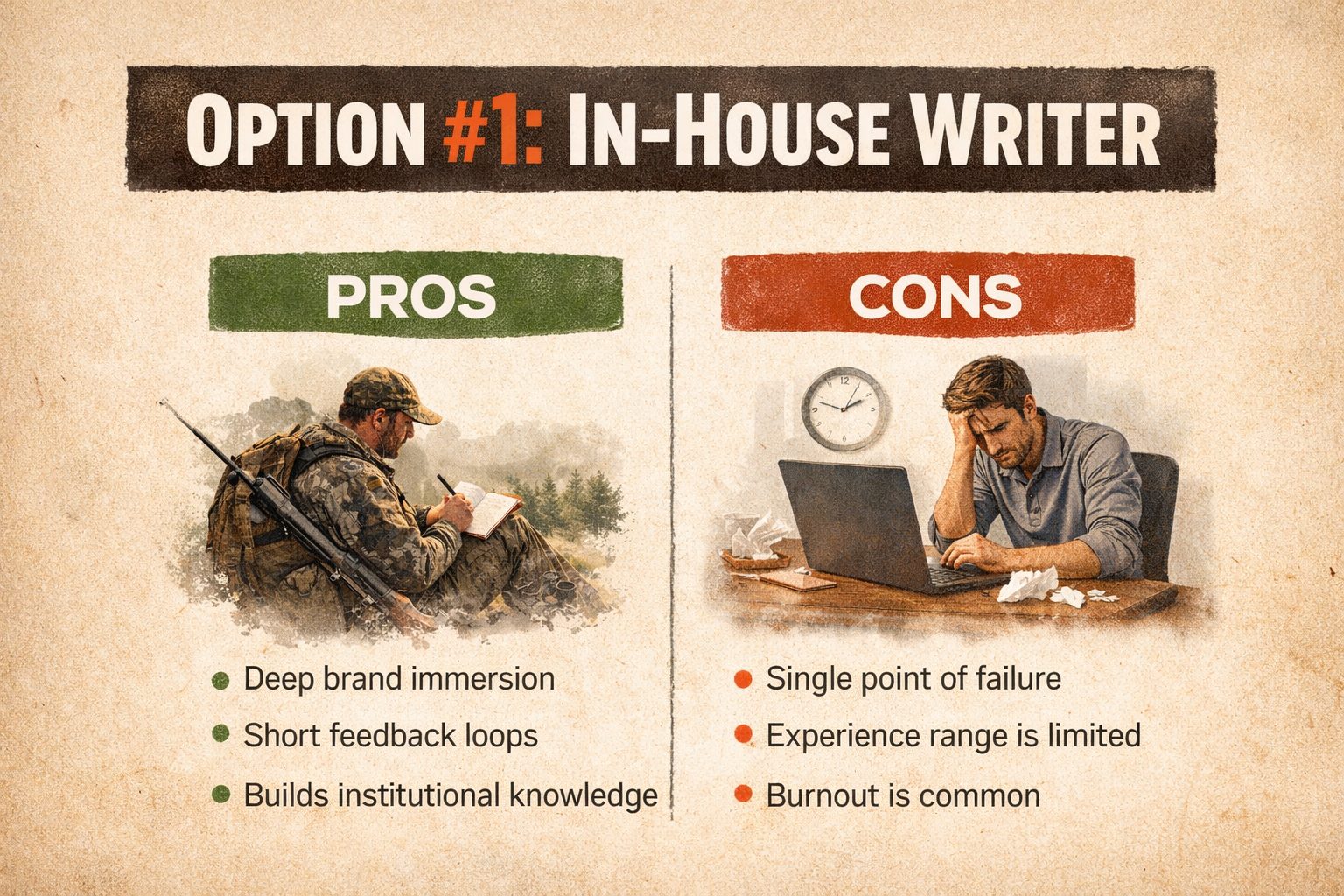
Pros of an In-House Writer
The biggest strength of having an in-house writer is proximity. Writers who work within your walls are deeply embedded in your brand voice, product lineup, and internal goals. Communication is fast, feedback loops are short, and cross-team alignment is easier to maintain.
In-house writers also build institutional knowledge over time. Launches, legacy products, messaging wins and fails, this all matters, but only to the people who are there when it happens. For brands with a narrow focus or a long content runway, that level of continuity can be quite valuable.
At very high content volumes, an in-house writer can also reach cost efficiency. Once salary and onboarding are sunk, output feels predictable on a month to month basis.
Cons of an In-House Writer
The challenge comes with range. One writer can only have one set of experiences. If they are a talented and resourceful writer, they can often stretch their range a bit. But at some point, it becomes inauthentic to write about topics and activities you have never done firsthand.
In the outdoor space, that quickly creates a ceiling.
Burnout is another risk. Depth, originality, and up-to-date research are all required for outdoor content to stand out. Continuously pumping out high-quality copy across multiple product categories or disciplines can lead to fatigue and declining quality in any one person.
Hiring is another challenge. There is a limited pool of writers who are both skilled communicators and experienced outdoorspeople. When that one person leaves, most brands' content momentum comes to a halt until the role is refilled.
Finally, most in-house content setups lack editorial redundancy. There is rarely a second set of experienced eyes, SEO is built into the role but not specifically strategic, and there is no buffer if priorities shift or deadlines slip. The system is only as strong as one person, which makes it fragile.
In an effort to fight this and stretch a small in-house team further, plenty of brands turn to AI. That works in many industries, but not in the outdoors where real experience matters. We wrote an entire article about that, read it here: AI Can Write, But It Can’t Hunt: Why Outdoor Brands Need Real Voices
Option 2: Working With a Content Agency
If the ideal in-house writer is a type-A creative generalist that works non-stop, a content agency might be its polar opposite: external, scalable, and hands-off.
That approach can be both a huge benefit and a liability for outdoor brands, depending on the agency. A great agency can bring structure, redundancy, and consistency that are tough to achieve in-house.
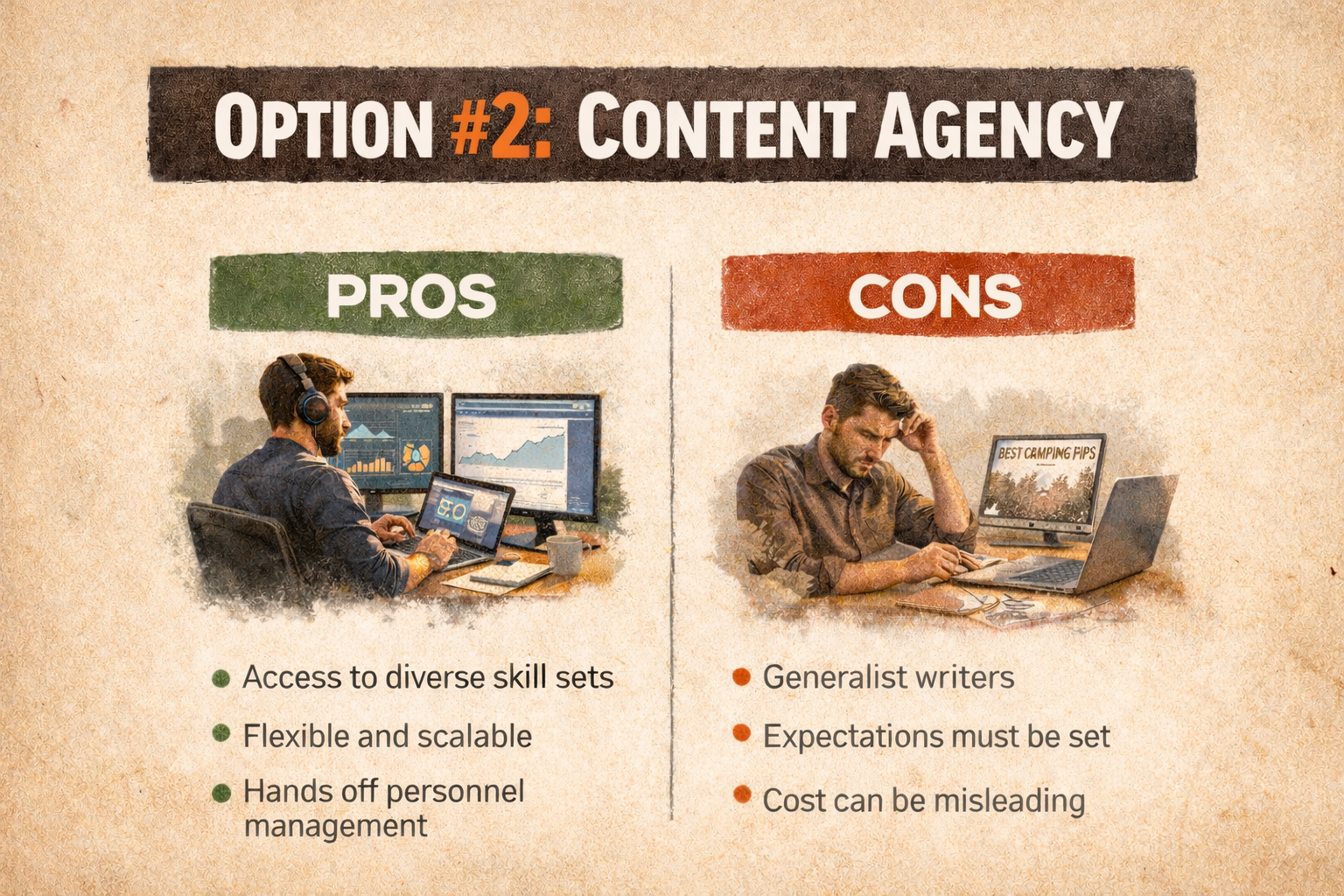
Pros of Working With a Content Agency
Access to diverse skill sets is the biggest benefit of using an agency. Instead of being limited to the background and skills of one or two writers, brands can align specific writers with specific topics.
A writer with backcountry hunting experience is probably a better fit for that topic than one with competitive shooting experience, for example. That depth and range of experience is important in the outdoor industry.
Agencies also have built-in editorial review. Editing, quality control, and SEO strategy is typically a part of the system, which minimizes drift and keeps content aligned across months and years. When one person is sick, on vacation, or leaves the company, output doesn’t grind to a halt.
Agencies are also more easily scalable than in-house content operations. Brands can increase or decrease volume as needed without hiring, onboarding, or restructuring teams internally. The flexibility to scale up and down as needed is especially helpful for seasonal hunting and shooting markets.
Management overhead is another benefit of a great agency. Planning topics, setting deadlines, making revisions, and optimizing for search and distribution are all the responsibility of the agency, which allows internal teams to focus on product, sales, and brand growth.
Cons of Working With a Content Agency
On the other hand, not all content agencies are built for the outdoor space. Many operate with generalist writers who research topics rather than having lived experience in them. That is a recipe for polished but soulless content that no one wants to read.
This is why C3 narrowly focuses on the hunting and firearms space, and doesn’t accept clients from outside that space.
There can also be a misalignment if expectations aren’t well established upfront. Agencies require more explicit direction around voice, goals, and success metrics than working with an in-house writer does. If those expectations aren’t well understood on both sides, the content can suffer.
Perception of cost can also be an issue. Agencies can look more expensive on paper than they actually are when you factor in the reduced internal workload and risk. Without a good understanding of true cost and opportunity cost, the value is easy to overlook.
The Hidden Costs and When Each Model Makes Sense
The in-house vs. agency decision often comes down to a crude cost comparison, but the real costs of each don’t become apparent until long after contracts are signed.
The biggest risk of an in-house writer is simply a lack of redundancy. One person controls the entire content machine. If they experience burnout, get swept into other projects, or change jobs, content momentum grinds to a halt and SEO gains dissipate quietly.
There is also a natural ceiling to experience. Even a strong writer will only have the background to cover so many subject areas before content starts to feel more generic.
In-house models make the most sense for larger brands with steady budgets, a narrow focus, and established editorial leadership. If a brand’s needs are stable and their scope is well-defined, this structure can work.
Agencies, on the other hand, present the opposite risk. Agencies that focus on cheap writers often result in hollow content that no one trusts. When quality isn’t there, volume only compounds the issue.
That being said, for most outdoor brands agencies are the right move. Agencies can provide a critical degree of flexibility, and the subject-matter expertise and editorial quality assurance that comes with specialized teams.
Agencies reduce single-point-of-failure and allow brands to scale content production without any hiring, onboarding, and HR headaches.
The budget is only one side of the equation. The limiting factor in most outdoor brands’ growth is actually bandwidth. Quality content needs more than just a writer, it needs a plan, editing, and strategy. The best structure for any brand is the one that upholds quality and consistency without distracting from the day-to-day.
The C3 Approach: Experience First, Systems Second
Most content agencies are system first and try to bolt-on experience later. Crosshair Content Co. (C3) starts with experience and figures out how to build systems around it.
The outdoor industry is our specialty, and every writer in our network is screened for boots-on-the-ground experience first. Our writers hunt, shoot, fish, and hang out in the field all the time. Experience is the base level expectation for a C3 writer, not an added feature.
Ability to write and SEO smarts are important, but not as important as credibility.
That’s why we don’t randomly assign writers to pitches. A subject is only matched to a writer who has actually used the gear, hunted the species, or been in the scenario being discussed. It helps guarantee content addresses real-world tradeoffs, failures, and decisions rather than generic ones.
Of course experience alone is not sufficient. Systems are how we close the gap.
Editorial oversight, SEO strategy, and quality control make sure that real-world experience turns into predictable results. Every article is screened for clarity, accuracy, and search intent, because we’re in the business of building authority that compounds, not just publishing content.
The net result is a model that eliminates the single-point-of-failure risk associated with in-house systems without resulting in the shallow output churned out by generalist agencies. Brands get depth, consistency, and flexibility without needing to staff writers internally.
In short, C3 gives outdoor brands the experience they actually need in the form of authentic content written by people who know the field and supported by systems that make it scalable.
If it sounds like C3 could help your brand with its content needs, we would love to talk. Click the button below to schedule a quick call with us or send us a message.
It’s Not About Where Your Writer Sits
For outdoor brands, in-house vs. agency is the wrong question. Where your writer sits is a lot less important than whether or not your content performs in the long run.
In-house models can work. Agencies can work. Neither are guaranteed. It’s not about structure, budget, or headcount. It’s about experience, consistency, and execution.
Outdoor audiences expect to read content that is authored by real people who have spent significant time outdoors. When you meet that expectation, readers stay on your site longer, explore more deeply, and return. When you don’t, even the most technically-flawless content is likely to underperform.
Search engines listen to those signals. Rankings go up or down based on the reactions of real people to the content you publish, not the efficiency with which it was produced.
The right setup is the one that lets your brand consistently publish experience-driven content that is authentic without consuming your internal resources or forcing you to sacrifice quality. If that’s an internal hire, great. If that’s an external partner, let’s talk.