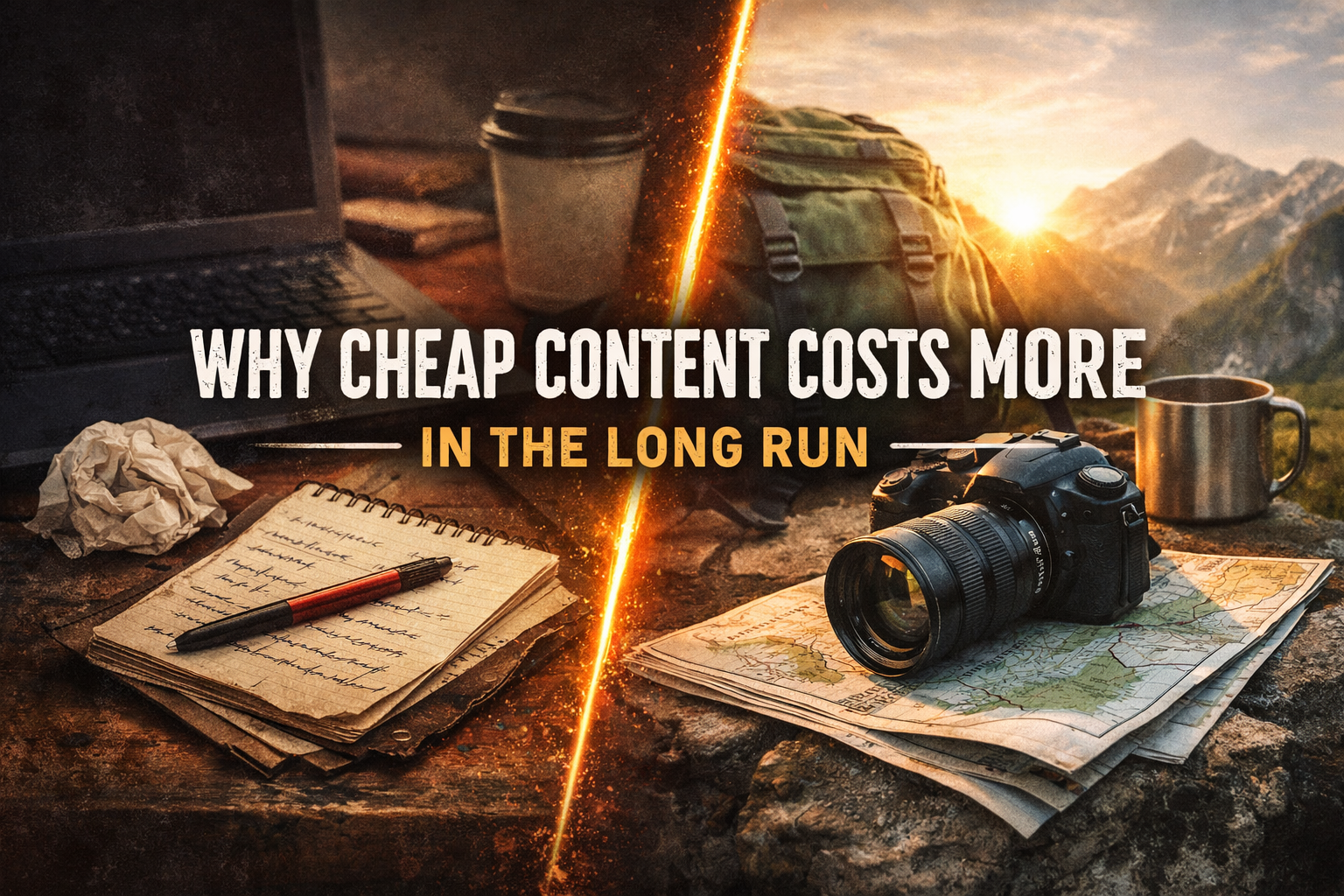

Cheap content feels like a safe decision.
The invoice is small. The turnaround is fast. And on the surface, it looks like progress; another article published, another box checked. For many brands, especially those trying to scale content quickly, it’s an easy choice to justify.
But over time, something starts to feel off.
The blog grows in size, yet traffic stays flat. Articles pile up, but none of them seem to rank meaningfully. Editing takes longer than expected. Updates feel pointless. And when performance questions come up, the answer is usually the same: “We’re publishing consistently, why isn’t this working?”
The problem isn’t that the content was inexpensive. The problem is that it never became an asset.
If you want to know more about turning a blog post into a real business asset, check out this article: Before & After: Turning a Basic Blog Into a Business Asset
Cheap content is optimized to exist, not to perform. It’s written to be completed, not to rank, convert, or build trust. And while the upfront cost looks attractive, the long-term cost shows up quietly in rewrites, missed opportunities, diluted brand authority, and content that never compounds.
In experience-driven industries like outdoor, hunting, firearms, and technical gear, that gap becomes even more obvious. Readers can tell when an article was assembled from surface-level research instead of real understanding. And once trust erodes, it’s expensive to earn back.
This is why the real question isn’t how much content costs per article. It’s what that content costs you over time.
Cheap Content Optimizes for the Wrong Metric
Most cheap content isn’t bad because of who wrote it, it’s bad because of what it’s designed to optimize for.
When content is priced low, the incentive structure shifts. Speed matters more than depth. Volume matters more than intent. The goal becomes finishing the article, not making it perform. As long as words are delivered and the topic roughly matches the brief, the job is considered done.
That works if the only metric that matters is “articles published.”
But publishing is not the same thing as progress.
High-performing content is optimized for a completely different set of outcomes: search intent alignment, reader trust, time on page, and long-term relevance. Those outcomes require more than surface-level research and a template-driven structure.
They require understanding why someone is searching, what they already know, what they’re skeptical of, and what questions actually move them closer to a decision.
Cheap content rarely accounts for any of that. Instead, it tends to follow the same predictable pattern: introduction, a handful of generic subheadings, a light conclusion. All assembled to meet a word count rather than a purpose.
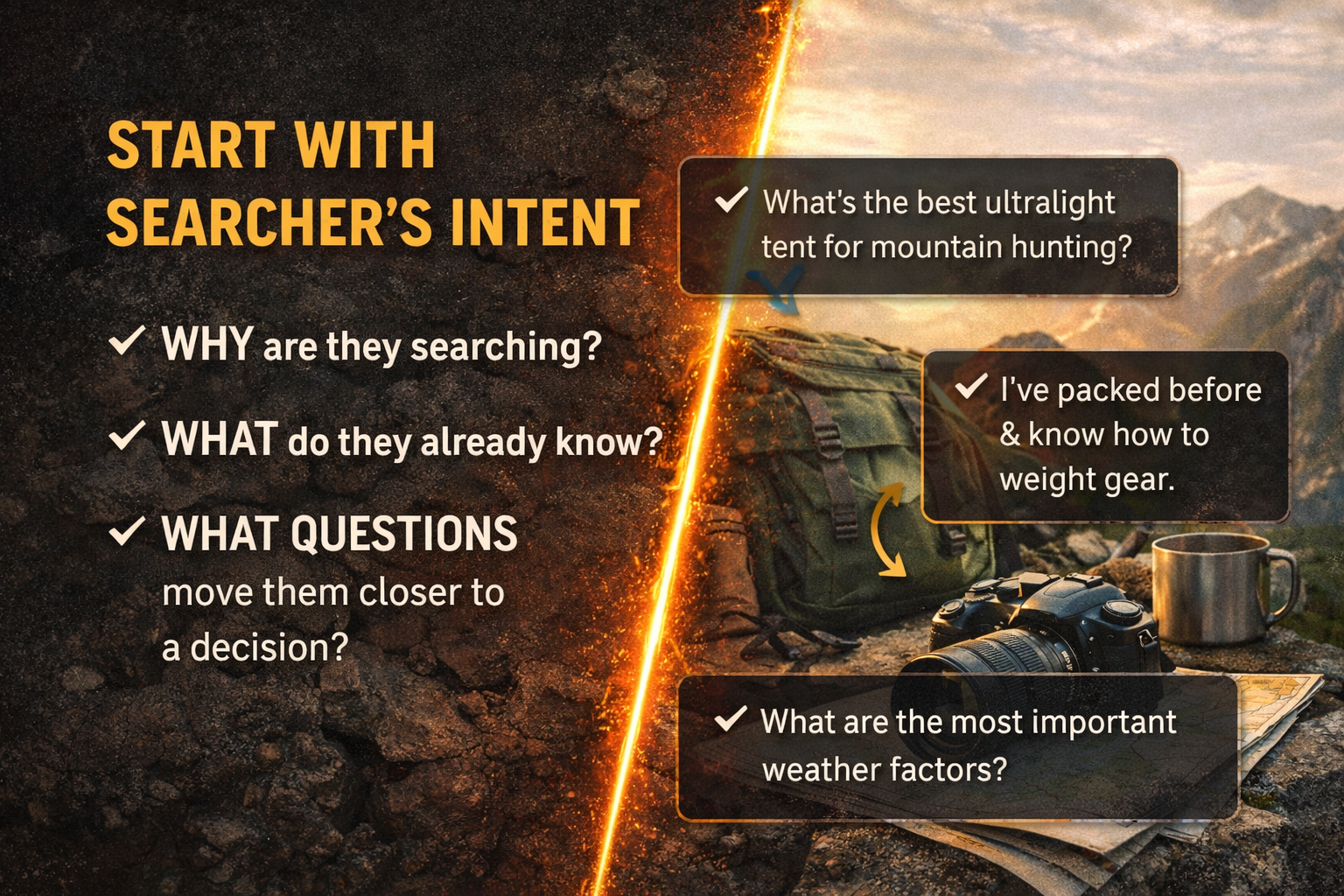
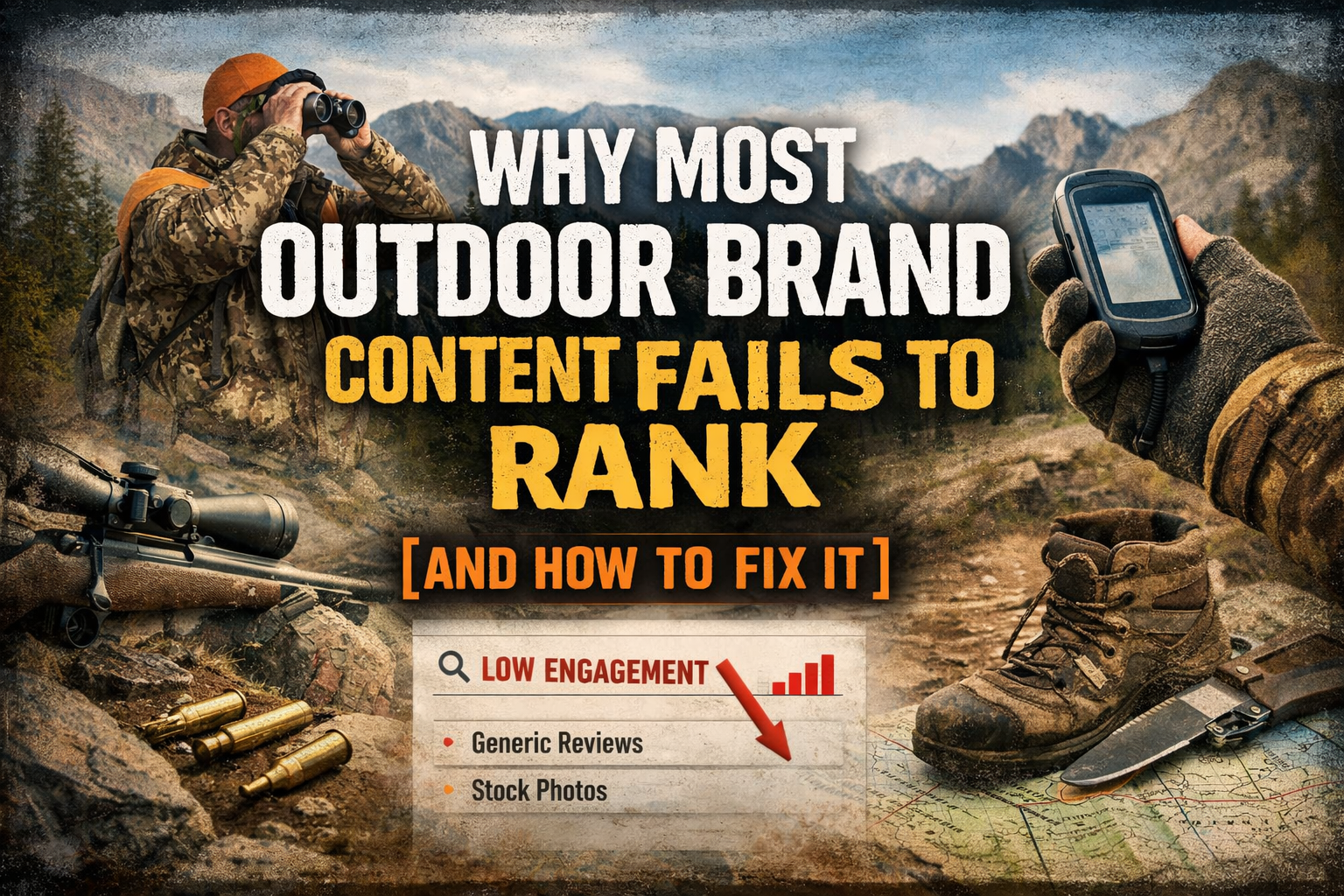
Authenticity and the “why” is one of the most important aspects of any article, if you want to learn about how to implement that correctly, read this article: Why Most Outdoor Brand Content Fails to Rank [And How to Fix It]
The result is content that technically exists, but doesn’t meaningfully compete. It doesn’t stand out in search results, it doesn’t build authority with experienced readers, and it doesn’t give search engines a reason to treat it as a credible resource.
The mismatch becomes obvious over time. Brands keep investing in more articles, assuming volume will eventually tip the scale, while each individual piece quietly underperforms.
Cheap content is efficient at getting published. Strategic content is efficient at creating leverage.
That difference is where the real cost begins to show.
We’ve seen this pattern repeatedly while auditing and rebuilding content libraries for outdoor and technical brands that were publishing consistently, but never seeing compounding returns.
The Hidden Costs Brands Don’t See on the Invoice
The real cost of cheap content rarely shows up where brands expect it to.
The invoice gets paid, the article gets published, and on paper, everything looks efficient. But the financial drag doesn’t come from the initial price; it comes from everything that follows. Cheap content creates downstream work, missed opportunities, and performance gaps that quietly compound over time.
Rewrites, Edits, and Cleanup Work
Low-cost content often requires more internal effort than anticipated. Articles need heavier editing, factual corrections, tone adjustments, or complete structural rewrites to align with brand standards or SEO goals. What looked like a finished deliverable becomes a starting point.
That extra work doesn’t just cost time, it pulls attention away from higher-leverage tasks. Marketing teams end up managing content instead of scaling it, and the savings from a cheaper article disappear quickly once multiple people are involved in fixing it.
In many cases, rewriting an underperforming piece takes longer than producing it correctly in the first place.
This is especially true nowadays with the rise of automated AI content. If you want to learn more about that, read this article: AI Can Write, But It Can’t Hunt: Why Outdoor Brands Need Real Voices
Content That Never Earns Visibility
One of the most expensive outcomes of cheap content is invisibility.
Articles that miss search intent, lack depth, or fail to demonstrate topical authority rarely earn meaningful impressions. They sit live on the site without traffic, links, or engagement, occupying space but generating no return.
From a cost perspective, this is worse than spending more upfront. An article that never ranks still consumes resources, still requires hosting and maintenance, and still represents a missed opportunity to capture qualified attention.
Would you rather have ten articles that no one ever sees, or one article that thousands click to every month?
Brand Dilution and Reader Trust
In experience-driven industries, readers can immediately tell when content lacks real understanding. Generic explanations, shallow comparisons, and overly cautious conclusions signal that the writer hasn’t actually lived with the product, process, or environment being discussed.
Over time, this erodes credibility. Even if individual articles seem harmless, a library of thin content trains readers, and search engines, to expect less from the brand. Trust becomes harder to earn, and authority becomes harder to establish, especially in competitive niches where expertise is the differentiator.
Once credibility slips, rebuilding it costs far more than the savings from cheap content ever justified.
Missed Compounding Value
High-quality content compounds. It earns rankings, internal links, updates, and long-term relevance. Cheap content rarely does.
Because it isn’t built with longevity in mind, it doesn’t age well. It can’t easily be expanded, refreshed, or reused across campaigns. When priorities change or SEO strategies evolve, those articles are often abandoned rather than improved.
The hidden cost here isn’t just replacement, it’s lost leverage. Content that could have grown stronger over time instead gets discarded and replaced, resetting progress instead of building on it.
Cheap content doesn’t fail loudly. It fails quietly through stagnation, rework, and opportunity cost.\
What High-Quality Content Actually Does Differently
High-quality content doesn’t succeed because it’s more expensive; it succeeds because it’s built with a different objective from the start.
Instead of optimizing for speed or volume, strategic content is designed to create leverage. Every decision, from topic selection to structure to depth, is made with performance and longevity in mind.
It starts with intent, not keywords.
Rather than chasing broad terms or filling a gap on a content calendar, high-quality content targets specific search intent. It anticipates what the reader is actually trying to solve, what objections they may have, and what information will help them make a decision.
This alignment is what allows an article to compete, not just exist, on the SERP.
High-performing content doesn’t stop at surface explanations. It covers tradeoffs, edge cases, and context that experienced readers expect to see.

That depth signals credibility to both readers and search engines, increasing time on page, engagement, and the likelihood of ranking for secondary queries over time.
Expertise is visible, not implied.
Instead of leaning on generic phrasing or hedged conclusions, quality content reflects real understanding. Whether that comes from firsthand experience, industry immersion, or subject-matter specialization, it shows up in the details.
Strategic content is built to be updated, expanded, and reused. It’s easy to refresh as products change, link internally as topical clusters grow, and adapt for future campaigns. That flexibility turns a single article into long-term infrastructure instead of a disposable post.
The result is content that improves with age rather than degrading over time. It earns rankings gradually, becomes a reference point within a site, and continues delivering value long after the initial publish date.
That’s the difference between content that fills space and content that carries weight.
How Brands Should Actually Evaluate Content Cost
The mistake most brands make isn’t spending too little on content, it’s evaluating content by the wrong criteria.
When cost is reduced to a per-article or per-word number, performance becomes an afterthought. A cheaper article looks efficient on a spreadsheet, even if it never ranks, converts, or earns trust.
That framing hides the real question brands should be asking: What does this content actually produce over time?
A better way to evaluate content cost is through outcomes, not invoices.
Instead of asking how much an article costs to publish, brands should ask whether it has a clear ranking target, whether it aligns with a specific stage of the customer journey, and whether it’s built to stay relevant long enough to justify the effort.
Content that can be updated, expanded, and internally linked carries far more value than content that has to be replaced once it underperforms. Longevity matters just as much as launch performance.
High-quality content is rarely finished on publish day. It’s refined, updated, and strengthened as a site grows. When an article is written with that future in mind, its cost is spread across months or years of traffic, conversions, and brand exposure.
Cheap content, by contrast, often has a short shelf life; if it doesn’t perform quickly, it’s abandoned.
Brands should also factor in internal time. Editing, managing, correcting, and rewriting content all carry real cost, even if it doesn’t appear on an invoice. Content that requires heavy oversight drains internal resources that could be spent on strategy, partnerships, or growth initiatives.
In many cases, paying more upfront reduces total workload rather than increasing it.
The most useful metric isn’t cost per article; it’s cost per asset. If one quality article that becomes an asset costs as much as five articles that will never bring in customers, it is worth it time and time again.
Content that ranks, supports conversions, and strengthens authority pays for itself repeatedly. Content that simply exists becomes a recurring expense. When brands shift their evaluation from price to performance, the economics of content change entirely.
Cheap content feels affordable. Strategic content proves its value.
What This Means for Outdoor & Experience-Driven Brands
Outdoor, hunting, firearms, and technical gear audiences don’t just want specs repeated back to them. They want to understand tradeoffs, real-world performance, limitations, and context.
They’re often making purchase decisions based on trust, not novelty, and they can immediately tell when an article was written by someone who hasn’t actually used the product or lived in the space.
That’s why cheap content is especially costly in these niches.
Surface-level writing doesn’t just underperform; it actively works against brand authority. Generic advice, cautious conclusions, and recycled talking points signal that the content was assembled, not earned.
Even when the information is technically correct, it lacks the depth that experienced readers expect, which makes the brand feel disconnected from the audience it’s trying to serve.

Search engines pick up on this too.
Experience-driven content naturally earns stronger engagement signals like longer time on page, deeper scroll depth, internal linking opportunities, and repeat visits.
When content reflects real understanding, it performs better not because it’s optimized harder, but because it resonates more clearly with the reader’s intent.
This is where many companies underestimate the stakes.
In highly competitive niches, credibility compounds slowly but collapses quickly. One thin article might be overlooked. A library of them redefines expectations. Over time, cheap content doesn’t just fail to build trust, it trains readers to look elsewhere.
For brands built on performance, reliability, and real-world use, content has to reflect those same standards. Otherwise, the savings on the invoice are outweighed by the long-term cost to reputation, visibility, and customer confidence.
Spend Less Time Replacing Content, More Time Benefiting From It
Content should reduce effort over time, not create more of it.
When articles are written with performance and longevity in mind, they become assets; pieces that can be updated, expanded, internally linked, and reused as a brand grows. They earn their place on a site and continue delivering value long after they’re published. That’s how content compounds.
Cheap content does the opposite. It requires constant replacement, revision, and oversight. It fills calendars but not pipelines. And while it may look efficient in the short term, it quietly increases workload while delivering diminishing returns.
The difference isn’t just quality, it’s intent.
Brands that treat content as infrastructure make fewer pieces work harder. They spend less time fixing and replacing articles and more time benefiting from them through consistent traffic, stronger authority, and clearer customer trust.
At Crosshair Content Co., this is the approach we take with outdoor and experience-driven brands. Our focus isn’t on producing the most content possible; it’s on creating durable, performance-minded pieces built by writers who understand the space they’re writing for.
Content that reflects real-world context, supports long-term SEO goals, and strengthens credibility instead of diluting it. Because in competitive niches, the most expensive content isn’t the kind that costs more upfront, it’s the kind you have to keep replacing.
If that sounds like something you would like help with, we would love to talk with you.